

Introduction
Magic mushrooms have become an increasingly visible part of conversations surrounding fungi, psychedelics, science and modern mushroom culture. While mushrooms have long been recognised for their culinary and ecological importance, certain species have attracted particular attention because they naturally contain psilocybin, a psychedelic compound that can produce significant changes in perception, mood and thought.
Interest in these mushrooms comes from several different directions. Some people are interested in fungal biology, while others explore their historical role in traditional practices or follow developments in psychedelic research. Online communities have also contributed to a growing culture around mushroom identification, cultivation, education and discussion.
However, the popularity of psychedelic mushrooms has also created an environment where accurate information can be difficult to distinguish from anecdotal experiences, exaggerated claims and misinformation. Understanding the basics of mushroom biology, terminology, history and responsible discussion can help create a more informed perspective.
For readers exploring the subject through resources such as Shrooms Direct, education is an important starting point. Rather than viewing magic mushrooms simply as another category of product, it is useful to understand the organisms themselves, the compounds associated with them and the wider culture that has developed around psychedelics.
What Makes a Mushroom “Magic”?
The term “magic mushroom” is generally used to describe mushrooms that contain naturally occurring psychedelic compounds, most notably psilocybin and psilocin. These compounds are responsible for the characteristic psychedelic effects associated with certain fungi.
Psilocybin itself is considered a prodrug because the body converts it into psilocin. Psilocin interacts with several serotonin receptors in the brain, particularly the 5-HT2A receptor. This interaction is associated with changes in sensory perception, cognition, mood and the way people experience their surroundings.
It is important to distinguish the mushroom from the compound it contains. A mushroom is a biological organism, while psilocybin is a chemical compound that may occur naturally within particular species. Different mushrooms can contain different concentrations of active compounds, and their chemical composition can vary.
The terminology surrounding these mushrooms can also be confusing. “Magic mushrooms”, “psychedelic mushrooms” and “psilocybin mushrooms” are often used interchangeably in everyday conversations, although they may have slightly different contexts. The term “psilocybin mushrooms” is generally more specific because it directly identifies the compound associated with their psychedelic properties.
Another important point is that not every mushroom that resembles a known psychedelic species is necessarily the same species or contains the same compounds. Accurate identification is therefore a serious matter. Wild mushrooms can be difficult to distinguish, and some poisonous species may resemble harmless varieties.
This is one reason mushroom education should begin with biology and reliable identification rather than assumptions based on photographs, names or informal descriptions.
A Look at the Diversity of Psilocybin Mushrooms
Psilocybin-containing mushrooms are not limited to one particular species. Several species within different fungal groups can naturally produce psilocybin and related compounds. This diversity is one reason mushroom culture includes extensive discussion about species, varieties and growing characteristics.
Names used within mushroom communities can sometimes be confusing. Scientific species names provide a more formal method of classification, while informal variety names may be used within enthusiast communities. These names do not necessarily provide a reliable indication of potency or predict the precise characteristics of a particular sample.
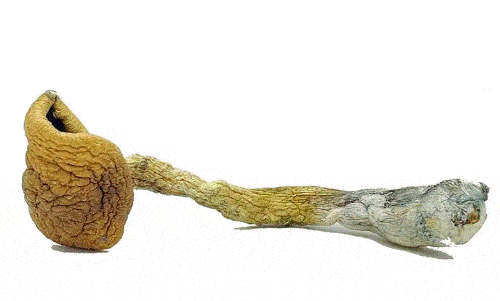
The physical appearance of mushrooms can also vary. Cap shape, colour, stem characteristics and size may differ depending on genetics and growing conditions. Environmental factors such as substrate, temperature, humidity and maturity can influence how a mushroom develops.
For this reason, appearance should not be treated as a straightforward measure of chemical composition. A larger mushroom is not automatically more potent, and visual differences do not necessarily indicate a completely different psychedelic profile.
The diversity of fungi also demonstrates why responsible mushroom culture places considerable emphasis on education. Misidentifying a wild mushroom can have serious consequences because poisonous fungi can sometimes look remarkably similar to edible or psychoactive varieties.
Modern mushroom communities therefore combine several areas of interest, including taxonomy, cultivation, microscopy, genetics and general fungal biology. Even people primarily interested in psychedelic culture can benefit from understanding the broader science of fungi.
This wider perspective also helps move conversations about magic mushrooms away from simplistic ideas about individual strains or products and towards a better understanding of the organisms themselves.
The Historical Roots of Mushroom Culture
The relationship between humans and psychoactive fungi is not a modern development. Archaeological and historical evidence has contributed to discussions about the traditional use of psychoactive plants and fungi in different cultures, particularly in parts of Central and South America.
Certain Indigenous communities developed cultural and ceremonial relationships with psychoactive mushrooms long before modern scientific research identified compounds such as psilocybin. These traditions should be understood within their specific cultural and historical contexts rather than reduced to modern recreational interpretations.
During the twentieth century, psychedelic mushrooms became increasingly visible in Western scientific and cultural circles. Researchers began investigating psilocybin and other psychedelic compounds, while psychedelic movements brought these substances into wider public discussion.
Scientific interest was later restricted in many countries as drug policies became more restrictive. In more recent decades, however, researchers have renewed interest in psychedelic compounds, leading to studies examining perception, consciousness and possible therapeutic applications.
This history illustrates how perceptions of psychedelic mushrooms can change over time. The same organism can be viewed through very different lenses: as a component of traditional culture, a subject of scientific research, a symbol of counterculture or an object of contemporary consumer interest.
Understanding this history provides useful context for modern mushroom culture. Today’s conversations did not emerge in isolation. They are connected to centuries of human interaction with fungi and several decades of changing scientific and social attitudes towards psychedelics.
It is also important to avoid presenting historical use as proof of safety or effectiveness. Cultural traditions, personal experiences and modern scientific evidence represent different forms of knowledge and should be considered separately.
How Modern Mushroom Culture Has Evolved
The internet has transformed how people discover and discuss mushrooms. Online communities have made it easier for enthusiasts to exchange information about fungal identification, cultivation, microscopy, taxonomy and psychedelic history.
Social media has further accelerated this process. Images of unusual mushrooms can reach large audiences, while educational content can introduce newcomers to fungal biology and psychedelic research. At the same time, online platforms can spread inaccurate information just as quickly as reliable information.
Modern mushroom culture therefore exists at the intersection of science, hobbyist communities, popular culture and ecommerce. Some communities focus primarily on mycology, while others are interested in psychedelic history or contemporary research.
Online dispensaries and specialised websites have also become part of this digital ecosystem. For readers researching Shrooms Direct Canada, for example, the broader context of mushroom culture can be just as important as understanding individual product categories.
A responsible online environment should encourage readers to examine information critically. Claims about potency, effects or health benefits can easily become exaggerated when they are based solely on personal anecdotes or marketing language.
Community knowledge can be valuable, but it should not automatically be treated as scientific evidence. A personal account describes one person’s experience and cannot establish that everyone will experience the same outcome.
This distinction is particularly important with psychedelics because individual responses can vary considerably. Biology, expectations, surroundings and other circumstances can all influence experiences.
As mushroom culture continues to develop, better access to reliable information can help ensure that growing interest is accompanied by greater understanding rather than simply greater availability of claims.
Responsible Perspectives on Psychedelic Mushrooms
Any discussion of magic mushrooms should include responsible considerations. Psilocybin is psychoactive, and its effects can significantly alter perception, judgement and coordination. These effects mean that activities requiring full attention, such as driving or operating machinery, can become dangerous.
Individual responses can also vary. Factors such as personal circumstances, expectations, physical condition and other substances may influence an experience. There is no universal response that can be guaranteed for every person.
Combining psychoactive substances can introduce additional uncertainty. Alcohol and other drugs can affect judgement and physical or psychological responses, making it difficult to predict how combinations will affect an individual.
Storage is another practical consideration. Psychoactive products should be kept securely and away from children, pets and anyone who could accidentally consume them.
Legal considerations are equally important. Laws relating to psilocybin and psychedelic mushrooms differ between jurisdictions and can change over time. Canadian readers should check current official information rather than assuming that online availability or changing public attitudes automatically means a product is legal in every circumstance.
Responsible discussion also means avoiding unsupported medical claims. Although psilocybin is being investigated in scientific and clinical research, research findings should not be confused with established medical advice or guarantees about individual outcomes.
A useful approach is to separate three different questions: What does scientific research currently show? What do individuals report from personal experience? And what is legally permitted in a particular jurisdiction? These questions can have very different answers.
Approaching psychedelic mushrooms through these distinctions creates a more balanced understanding and helps readers avoid both exaggerated enthusiasm and unnecessary misinformation.
Why Education Matters When Exploring Mushroom Products
The growing interest in magic mushrooms makes reliable education more important than ever. Consumers and enthusiasts encounter information from scientific publications, online communities, product descriptions, social media posts and personal accounts, but these sources do not necessarily have the same level of reliability.
A useful starting point is learning the terminology. Understanding the difference between species, varieties, psilocybin, psilocin, dried mushrooms and mushroom-infused products can make online information easier to interpret.
Product information should also be read carefully. Clear descriptions, relevant ingredients and transparent policies can help readers understand what they are looking at without relying on vague marketing terminology. Terms such as “premium” or “strong” may have limited meaning unless supported by objective information.
Readers should also be cautious about claims that promise particular psychological, physical or medical outcomes. Psychedelic experiences are highly individual, and personal testimonials cannot establish predictable results for everyone.
Education also extends beyond the product itself. Understanding impairment, responsible storage, interactions with other substances and local regulations is part of approaching psychedelic topics responsibly.
For people interested in mushroom culture, education can be rewarding even without focusing on consumption. Mycology, fungal ecology, taxonomy, history and psychedelic science all offer substantial areas for exploration.
The broader mushroom community benefits when discussions are based on curiosity and evidence rather than sensationalism. As scientific research continues and public attitudes evolve, informed readers are better positioned to distinguish established knowledge from speculation.
Ultimately, understanding magic mushrooms means looking beyond the word “magic”. These organisms sit at the intersection of biology, chemistry, history, culture and modern science. Exploring each of those dimensions provides a much more complete picture.
Conclusion
Magic mushrooms are much more than a category within psychedelic culture. They represent a fascinating intersection of fungal biology, natural chemistry, history, scientific research and modern online communities.
Understanding psilocybin and psilocin helps explain the scientific basis of their psychedelic properties, while learning about different species demonstrates the diversity of fungi. Historical context shows that human relationships with psychoactive mushrooms have developed across different cultures and periods, while modern digital communities have created new ways for people to share information and ideas.
At the same time, increased interest makes responsible education especially important. Online claims, personal anecdotes and promotional language should not automatically be treated as evidence. Readers can develop a more balanced perspective by comparing information from reliable sources, understanding individual variability and remaining aware of safety and legal considerations.
Whether someone approaches mushrooms through mycology, history, science or contemporary mushroom culture, the subject offers plenty to explore. A thoughtful understanding begins with curiosity, continues with reliable information and recognises the difference between what is known, what is being researched and what remains uncertain.
Leave a Comment