

For many high school students in the United States, from AP Physics tracks to standard curriculum courses, the “lab report” often feels like a daunting hurdle. However, a physics lab report is more than just a homework assignment; it is a formal communication of scientific discovery. Whether you are measuring the acceleration of a falling object or calculating the resistance in a circuit, your report must be precise, objective, and logically structured.
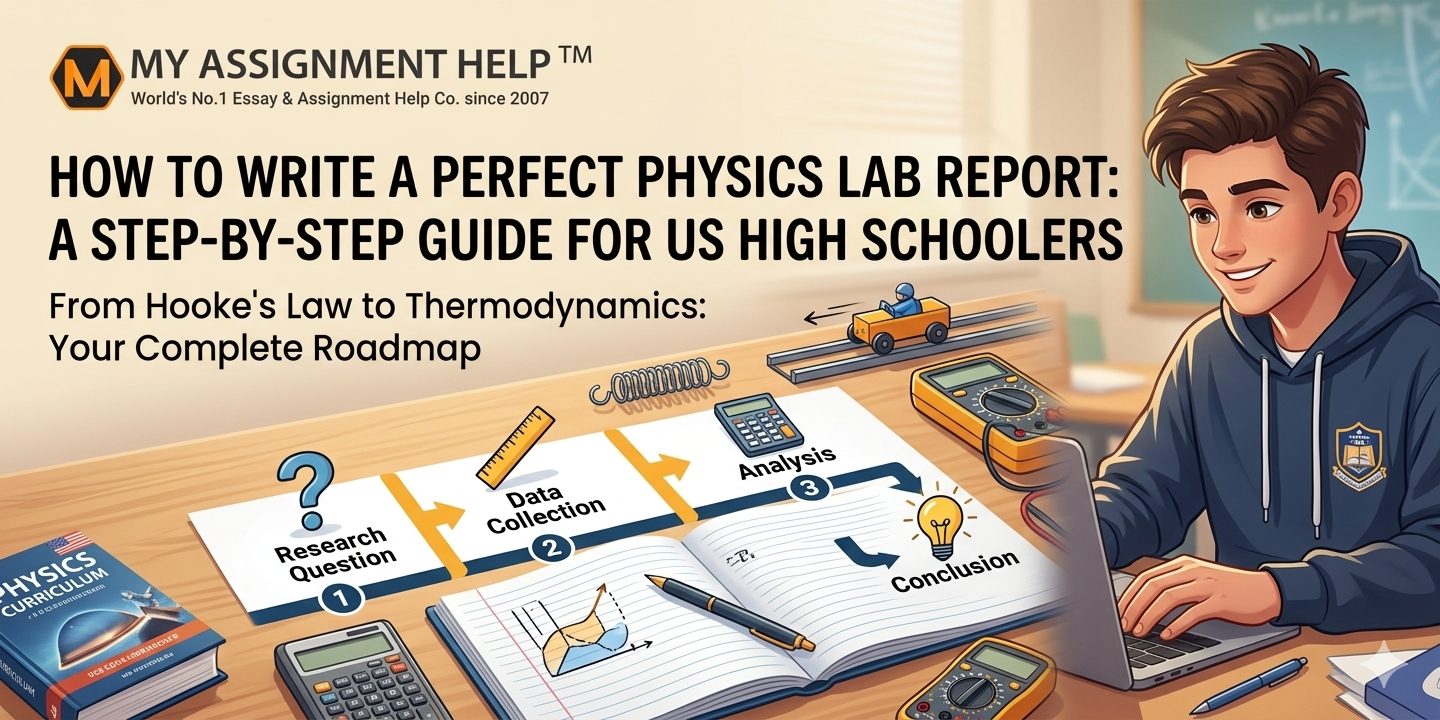
According to data from the National Center for Education Statistics (NCES), proficiency in science among high schoolers often hinges on the ability to translate experimental data into written analysis. Mastery of the lab report format is a critical skill that prepares students for college-level STEM (Science, Technology, Engineering, and Mathematics) courses.
The Strategic Importance of the Lab Report
Writing a lab report is an exercise in the scientific method. It requires you to move beyond simply “doing” the experiment to “explaining” the experiment. In the competitive landscape of US college admissions, demonstrating a high level of scientific literacy through well-documented lab work can be a significant differentiator.
If you find yourself struggling with the complexities of Newton’s Laws or Maxwell’s equations while drafting your documentation, seeking professional physics assignment help can provide the clarity needed to bridge the gap between raw data and a polished final draft. Expert guidance ensures that your technical terminology is accurate and your mathematical derivations are sound.
Step-by-Step Structure of a Perfect Physics Lab Report
To achieve an “A” grade, your report should follow a standardized format recognized by the American Association of Physics Teachers (AAPT).
1. Title Page
Your title should be descriptive and professional. Instead of “Gravity Lab,” use “Determining the Acceleration Due to Gravity Using a Simple Pendulum.” Include your name, lab partner names, date, and instructor’s name.
2. The Abstract
The abstract is a concise summary (typically 100–150 words) of the entire report. It should state the objective, the basic method used, the key results (including numerical values with uncertainties), and the primary conclusion.
3. Introduction and Hypothesis
Define the purpose of the experiment. What physical principle are you testing? State your hypothesis in an “If… then…” format. For example: “If the length of a pendulum is increased, then its period of oscillation will increase proportionally to the square root of the length.”
4. Materials and Methods
List all equipment used (e.g., photogates, vernier calipers, triple-beam balances). Describe your procedure in the past tense and passive voice.
- Pro-Tip: Instead of saying “I measured the ball,” write “The diameter of the sphere was measured using a metric micrometer.”
5. Data Collection and Analysis
This is the heart of your report. Data should be organized into neat tables with clearly labeled headers and units (SI units are standard in US high schools).
For students balancing multiple subjects, the pressure to maintain this level of detail can be overwhelming. If you are feeling spread thin, you might decide to hire a professional to do my assignment to ensure that your secondary subjects don’t suffer while you focus on your core science projects.
6. Calculations and Error Analysis
Physics is the study of uncertainty. You must include:
- Sample Calculations: Show one example of every formula used.
- Error Analysis: Calculate the percent error between your experimental value and the accepted theoretical value.
- Formula: $|(\text{Experimental} – \text{Theoretical}) / \text{Theoretical}| \times 100\%$
7. Results (Graphs)
In US high school physics, “Line of Best Fit” is king. Use software like Excel or Google Sheets to create scatter plots. Ensure your axes are labeled with the variable name and the unit.
8. Discussion and Conclusion
Analyze your results. Did they support your hypothesis? If not, why? Discuss “sources of error”—but avoid “human error.” Instead, look for “friction in the pulley,” “air resistance,” or “limitations in equipment precision.”
Data-Driven Insights: Common Pitfalls
Research into student performance shows that 40% of points lost in lab reports are due to:
- Missing Units: Forgetting to add “m/s²” or “Joules.”
- Significant Figures: Not following standard “Sig Fig” rules throughout calculations.
- Vague Conclusions: Failing to relate the data back to the original physical law.
Key Takeaways
- Precision Matters: Always use SI units and maintain consistent significant figures.
- Passive Voice: Write as an objective observer, not a participant.
- Analyze Errors: Identifying why your experiment wasn’t perfect is often more important than the result itself.
- Visual Clarity: Use tables and graphs to make your data digestible at a glance.
FAQ Section
Q: Can I use “I” or “We” in my report?
A: Generally, no. US high school standards prefer the third-person passive voice (e.g., “The data was recorded” instead of “I recorded the data”).
Q: What is the difference between “Accuracy” and “Precision”?
A: Accuracy is how close your measurement is to the true value. Precision is how consistent your measurements are with each other. A good lab report addresses both.
Q: How do I cite sources in a physics lab?
A: Most US schools use APA or MLA format. Ensure you cite your textbook or any online databases used for “accepted values” of physical constants.
Q: Should I include “Human Error” in my discussion?
A: Avoid this term. It is too vague. Specify the type of error, such as “reaction time in stopwatch operation” or “parallax error when reading the graduated cylinder.”
About the Author: Sarah Miller
Sarah Miller is a Senior Content Strategist and Academic Consultant at MyAssignmentHelp. With a Master’s degree in Science Education and over a decade of experience in the US K-12 sector, Sarah specializes in helping students demystify complex STEM subjects. Her work focuses on bridging the gap between classroom theory and practical application, ensuring students meet the rigorous standards of the American curriculum.
References and Sources:
- American Association of Physics Teachers (AAPT). (2023). “Recommendations for the Undergraduate Physics Laboratory Curriculum.”
- National Center for Education Statistics (NCES). (2024). “Science Achievement Levels in US High Schools.”
- The College Board. (2025). “AP Physics 1 and 2 Inquiry-Based Lab Investigations.
Leave a Comment