

The alarm goes off. You open your eyes, ready to start the day, but as soon as you try to roll out of bed, your body protests. Your back is stiff, your joints feel rusty, and your muscles ache as if you ran a marathon in your sleep.
If this sounds familiar, you aren’t alone. Morning stiffness is a incredibly common complaint, and it isn’t reserved solely for the elderly or elite athletes. While a few minutes of stretching usually loosens things up, starting every single day in physical discomfort can be draining.
While many people blame their mattress or their sleeping position, the root cause often goes deeper. And surprisingly, the solution might be right beneath your feet—or rather, underneath your sheets—in the form of an earthing mat.
The Science Behind Morning Soreness
Why does the body feel stiffest right after a long rest? It seems counterintuitive. Shouldn’t sleep be restorative?
While sleep is indeed when the body repairs itself, that repair process involves inflammation. During the night, your body suppresses anti-inflammatory hormones to focus on fighting off pathogens and healing tissue. This can lead to a morning peak in inflammatory markers.
Additionally, there is the issue of fascia. Fascia is the connective tissue that surrounds your muscles. Overnight, the fluids that lubricate this tissue can thicken, becoming viscous and glue-like (a process sometimes called “fuzzing”). This lack of lubrication causes that rusty feeling until you move around and warm up the fluids again.
Poor circulation caused by remaining stationary for hours also contributes, allowing metabolic waste products to accumulate in the muscles, leading to soreness.
What Are Earthing Mats?
To understand what an earthing mat is, you first have to understand the concept of “grounding.”
Think about the last time you walked barefoot on damp grass or a sandy beach. You likely felt a subtle sense of relief or calm. Grounding proponents argue this isn’t just psychological; it’s electrical. The Earth carries a subtle, negative electrical charge. When you make direct skin contact with the ground, you absorb electrons that theoretically help stabilize your body’s bioelectrical environment.
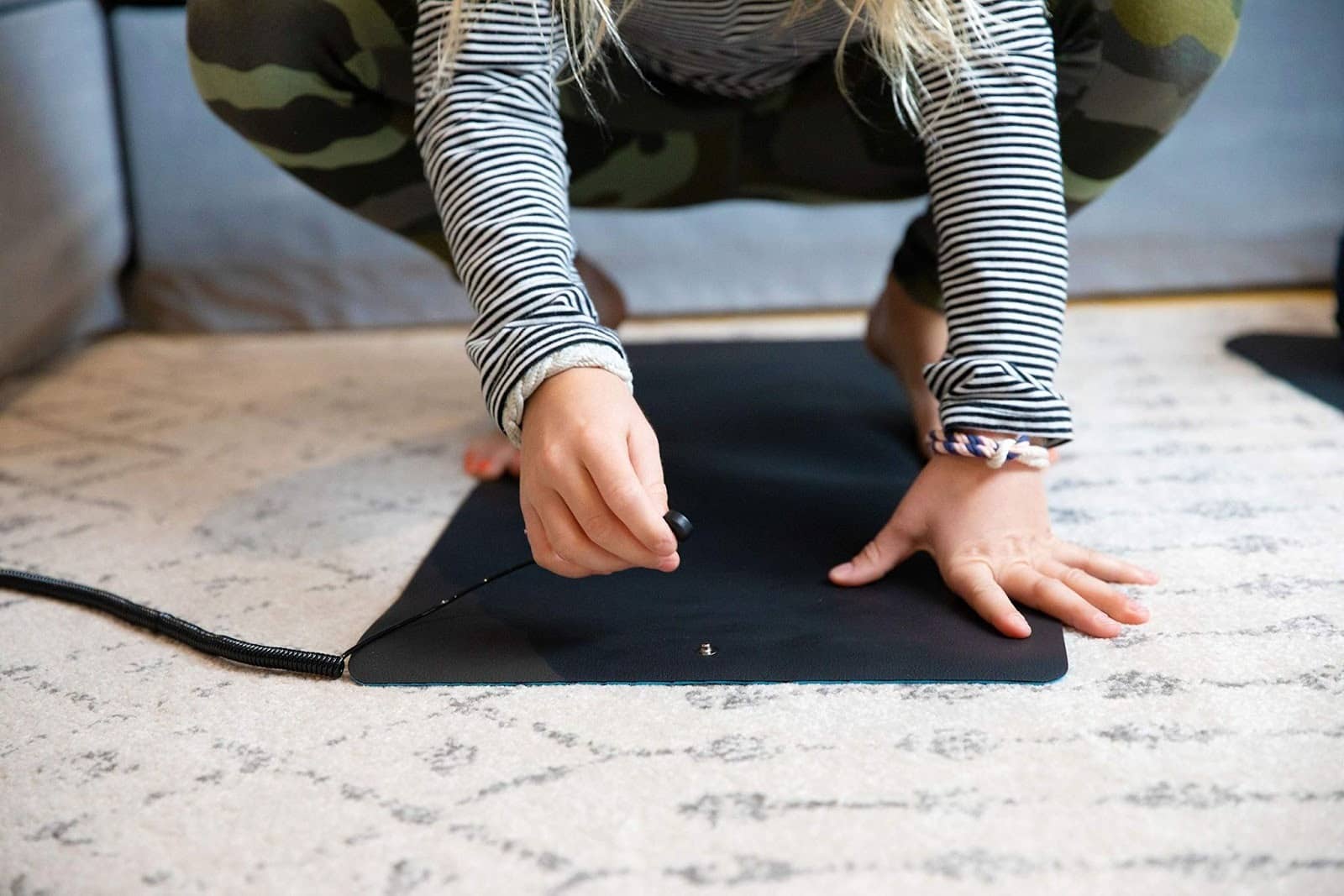
In modern life, we rarely touch the earth. We wear rubber-soled shoes and live in insulated houses. An earthing mat is a device designed to replicate that connection indoors. Typically made from conductive materials like carbon or silver, these mats plug into the ground port of a standard electrical outlet (they don’t use electricity, they just connect to the ground wire).
Essentially, an earthing mat attempts to bring the benefits of walking barefoot on the grass into your bedroom or office.
How Grounding Reduces Inflammation and Pain
The primary theory behind the benefits of earthing is the “electron transfer.”
Free radicals are unstable atoms that can damage cells, causing illness and aging. They are positively charged and lack electrons. Inflammation produces free radicals. The Earth, however, is an infinite source of negatively charged electrons.
When you use an earthing mat, the theory suggests that these free electrons flow from the earth into your body, neutralizing the positively charged free radicals. This acts as a powerful, natural antioxidant defense system.
Research published in the Journal of Inflammation Research suggests that grounding can reduce pain and alter the numbers of circulating neutrophils and lymphocytes, indicating a modulation of the immune response. By reducing chronic inflammation, grounding may help alleviate the morning stiffness that many people accept as a normal part of life.
Furthermore, grounding has been shown to normalize cortisol profiles. Cortisol is the stress hormone that affects sleep quality. Better sleep regulation allows the body to heal more efficiently, potentially reducing the “morning ache.”
How to Use Earthing Mats for Best Results
Incorporating this tool into your routine doesn’t require extra time—just a change in setup.
- Direct Skin Contact: The most critical rule is that bare skin must touch the mat. Most people place the mat horizontally across the bottom of the bed so their calves and feet rest on it while they sleep.
- Under the Desk: If you don’t want it in bed, place a mat under your desk and rest your bare feet on it while you work.
- Consistency: Like diet or exercise, the effects are cumulative. Sleeping on the mat for eight hours a night is generally considered the most effective method because it provides a long, uninterrupted period of grounding during the body’s peak healing time.
Conclusion
Waking up sore doesn’t have to be your default setting. While stretching and hydration are essential, addressing the underlying inflammation and cortisol imbalances could be the key to pain-free mornings.
An earthing mat offers a passive, non-invasive way to reconnect with the earth’s natural energy. By potentially neutralizing free radicals and lowering inflammation while you sleep, it might just be the missing link between you and a refreshing morning.