

Every few years, game development goes through a shift that changes who can make games and what kinds of games they can make. Desktop publishing tools let writers produce games without physical print runs. affordable middleware lets small studios build with engines previously reserved for well-funded companies. Mobile platforms let individual developers reach audiences of millions. Each shift felt significant at the time and, in retrospect, was — but none of them changed the fundamental act of game creation as profoundly as what’s happening now.
The AI game agent is the most significant change in game creation since the game engine itself. It separates the act of imagining a game from the act of building one in a way that nothing before it has managed. And critically, it’s not finished. What exists now is impressive. What exists in three years will be substantially more capable. The vibe coding game movement — games made from feeling-first prompts, without technical planning — is an early signal of where creator culture is heading as these tools mature. The people building games that way today are developing intuitions and workflows that will be even more powerful as the underlying capabilities improve.
Where We Are Right Now Is Not Where This Ends
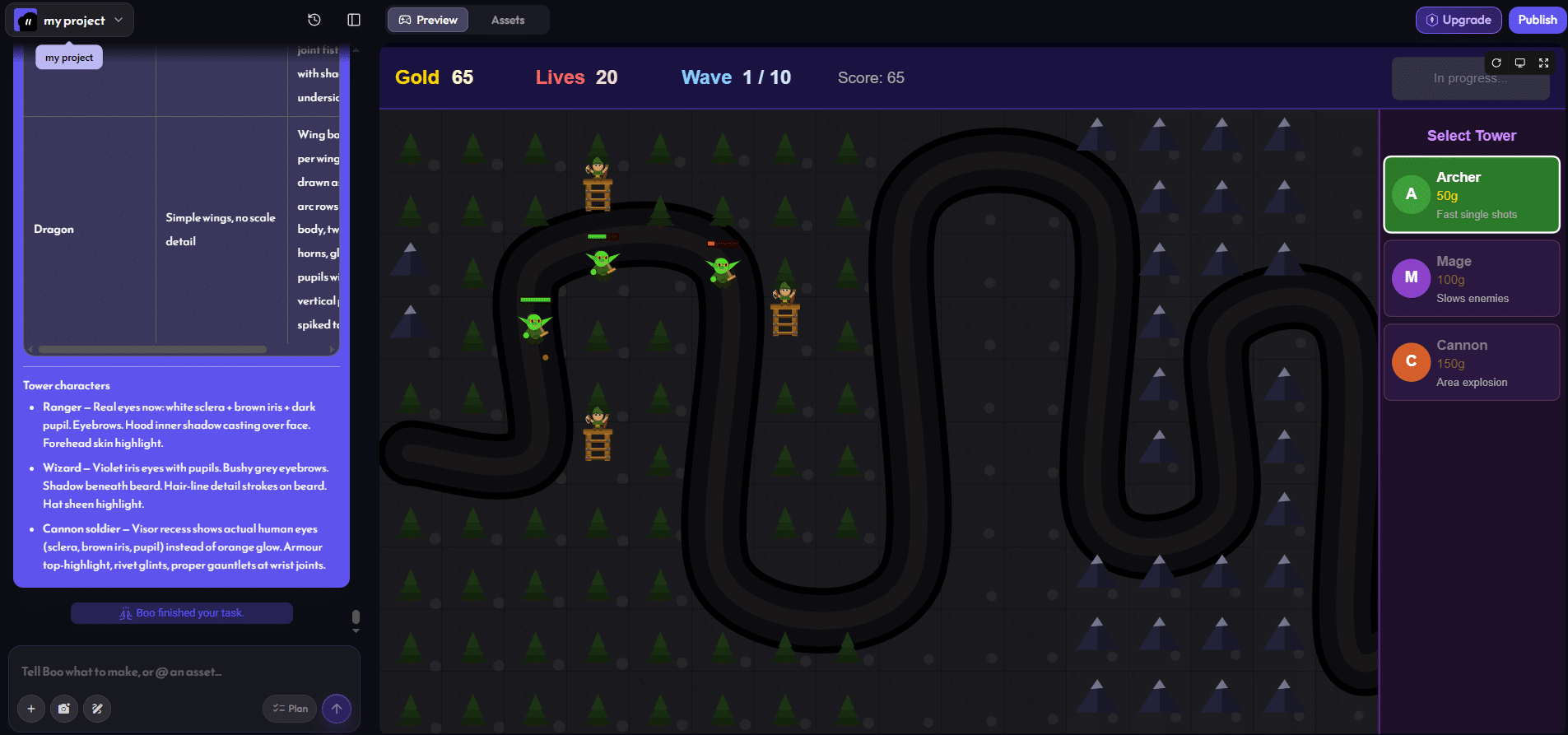
Current AI game agents are genuinely useful. They prototype fast, generate consistent assets, build logical game systems, and produce playable builds in sessions rather than sprints. They’re not perfect — the most complex game designs still require significant human intervention, and the quality ceiling for agent-built games is lower than what an experienced team can produce with dedicated time.
That quality ceiling is rising. The trajectory of AI capability over the last three years suggests it will continue rising faster than most people’s intuitions account for. The agent you’re using today is not the agent you’ll be using in two years.
The Capabilities That Are Coming in the Next Two to Three Years
The areas where current agents have most obvious limitations are also the areas where the most active development is happening. Dialogue quality and narrative coherence — currently solid but sometimes generic — will become genuinely expressive as language models improve. Adaptive difficulty systems that respond to individual player behaviour in real time, rather than following a fixed curve, are close. Multiplayer architecture, which current agent tools largely avoid because of its complexity, is a likely next frontier.
More significant than any individual capability is the improvement in what might be called creative fidelity — how accurately the agent translates a specific creative vision into a finished game. The gap between ‘what I imagined’ and ‘what the agent built’ will narrow. For creators, that narrowing changes the relationship from directing an imperfect collaborator to working with something that genuinely understands what you’re going for.
What Happens When Every Creator Has an Agent in Their Toolkit
The most important consequence of AI game agents becoming standard isn’t the games that get made — it’s who makes them. Right now, game creation is still dominated by people with technical backgrounds or the financial resources to hire them. That population is about to expand dramatically.
Writers will make games. Visual artists will make games. Musicians, educators, designers working in other fields, people who have stories to tell in interactive form but have never had a practical path to telling them — all of these groups will enter game creation in significant numbers. The culture of games will reflect that diversity in ways it currently doesn’t.
The New Creative Questions That Will Replace the Old Technical Ones
Right now, a significant portion of the creative energy in game development goes toward solving technical problems. How do I make this mechanic feel right? How do I get the assets to match? How do I get the difficulty curve to work without a full playtesting team? These are important questions, but they’re downstream of the real creative question, which is: what kind of experience do I want to create and why does it matter?
As agents handle more of the technical layer, creators will spend more time in that upstream territory. That’s a better use of creative capacity. It’s also more demanding — it requires genuine artistic vision rather than competent execution. The tools are becoming more powerful; the questions they enable are becoming harder.
Risks, Concerns, and the Conversations the Industry Needs to Have
The rise of AI in game creation isn’t without legitimate concerns. The question of what happens to studios built around traditional development workflows is real. Artists and developers who’ve spent years building specific technical skills face a genuine shift in the value of those skills. The industry will need to find ways to acknowledge and address that transition honestly.
There are also questions about creative ownership, about the training data underlying these models, and about what it means for a creative work to be ‘yours’ when an agent built significant portions of it. These aren’t questions with clean answers, and the honest response is to hold them seriously rather than dismiss them in the enthusiasm about capability.
Game Creation Has Never Been More Open — and It’s Only Getting More So
Whatever the legitimate concerns about the transition, the direction of travel is clear: game creation is opening up. The technical and financial barriers that kept most people who had ideas for games from making them are collapsing. That opening won’t be clean or uncomplicated, but it is happening.
The games that come out of this expanded creator pool will be stranger, more personal, more diverse in their concerns, and more willing to take risks than the games produced by a smaller industry optimising for known markets. Some of those games will be bad. Many will be interesting. Some will be unlike anything that exists right now, because the people who will make them weren’t previously in a position to make anything.
Conclusion
The AI game agent is a genuinely significant development in the history of game creation. Not because it makes existing game development faster, though it does. But because it changes the population of people who can make games, the range of games that get made, and the creative questions that creators spend their time on. That’s a cultural shift as much as a technical one — and it’s only the beginning.